
Triduum 2025
Part 2: Holy Saturday - From Death to Resurrection

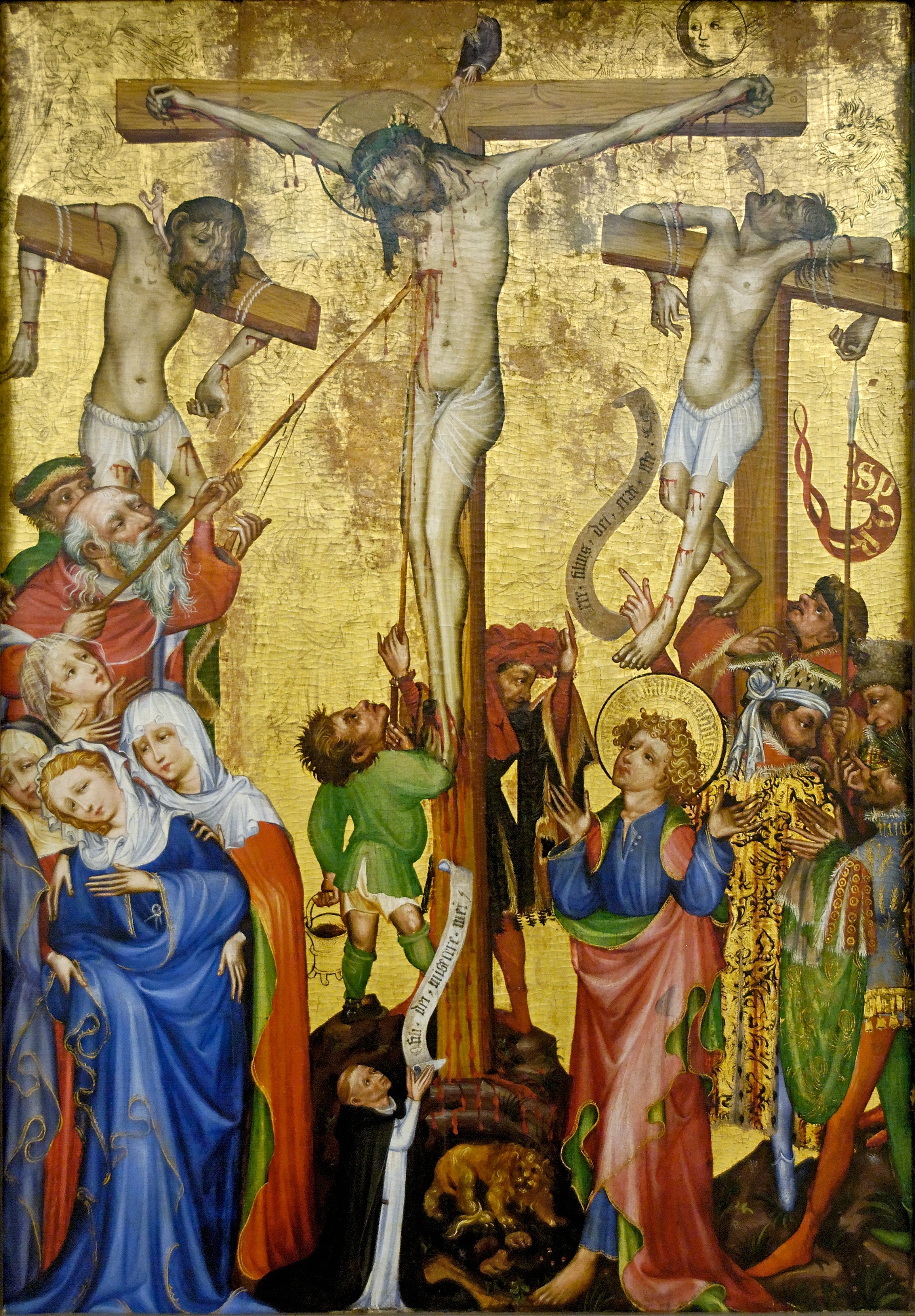
The Crucifixion of Christ, oil on wood panel, artist unknown, circa 1410AD
There’s an awful lot to cover in this post - all but the entire Paschal Mystery, in fact.
Suffice it to say that this is perhaps the simplest reason for my mystical-literalism on all of these topics: it’s simpler to take the Gospels and the Creed as they stand than to make vaunted arguments based on philosophy and theology about the same questions.
Christ told us repeatedly that the Son of Man - Himself - would be killed by the very people he was sent to save. He also told us that on the third day, He would rise again.
In the Apostles’ Creed, the standard for all baptized Christians since the earliest days of the Church, we are told that Our Lord Jesus Christ:
…suffered under Pontius Pilate,
was crucified, died and was buried;
he descended into hell;
on the third day he rose again from the dead…
And so we can simply take it from there, for the sake of brevity. Those who would like to quibble are welcome to do so in the comment section that is not yet activated.
The Death of God
In the Passion narrative, meaning is as prevalent and pungent as the wounds of the stricken Christ himself.
From the biological reality of the torture Jesus suffered, to the political situation that made His death expedient, to the spiritual epiphanies that follow His footsteps and surround the crest of Golgotha, there’s no end of possible vignettes to draw from.
But for our purposes here, I want to simply state that at the heart of this scene, the Way of the Cross, there is a simple, blunt fact: we, humanity, God’s highest achievement in all of creation, murdered our Creator. Or, as dear old Nietzsche put it nearly two millennia later: God is dead, and we have killed him.
Why dwell on such a dark and ignoble point?
Because what good is free will if you cannot use it to either give oneself entirely to God and His plan, or to reject Him and His will so entirely, as to literally destroy Him?
“I am the way, the truth, and the life: no man cometh unto the Father, but by me.”
The world’s answer, our answer to this proposition? Death in it’s most cruel form at the time: crucifixion on a cross.
And we reveled in it. We demanded the death as a mob, spat on the victim as He ascended Skull Hill, and then mocked Him all the way to His last breath. It’s the worst thing we as humanity have ever done, and we did wit with reckless abandonment.
Christ’s response?
“Forgive them Father, for they know not what they do.”
“Today you shall be with me in paradise.”
“Father, into your hands, I commend my spirit.”
We don’t deserve that kind of mercy. No matter how blameless we are, none of us can fathom being that generous, that selfless, that loving in such a state of agony and woe. People make excuses for far less innocent people who cuss their way through their last few breaths. But to bless and forgive from an instrument of torture?
The contrast is necessary. Because it must strike us in the heart, as sharply as the lance that pierced Christ’s side. Love incarnate offered Himself to us, and we murdered Him in response. Again, all of this happens inside of a week - we were happy to wave palm fronds a few days ago, now we’ve greedily called for His death.
Jesus is taken down and buried by some of His disciples - some, because most of the Apostles have scattered, from His arrest onwards. The Gospels do not recount Peter’s presence at the Cross. Only John, the beloved disciple, and Mary, the Mother of God, as well as Joseph of Arimathea and Nicodemus.
Jesus is wrapped in linen and placed in a new tomb, as swiftly as possible to keep the Sabbath on the highest day of the Jewish calendar. The rock is rolled in front of the tomb and a guard is posted outside.
Jesus is as dead as a doornail, as far as the authorities are concerned, and they intend to keep Him that way. There is likely some back slapping “well-done” comments in certain quarters, and the rest of the Passover carries on…
Descended into Hell
I knew a priest once - a Benedictine monk-priest on the run from a wayward Abbey, actually - who happened to have completed his doctorate in Holy Saturday, i.e. “He descended into Hell.” He gave a talk every Holy Saturday propounding his own as well as others’ theories on what this meant and what took place whilst Christ was dead.
Unfortunately, in the brief few years I knew him and that he directly me spiritually, I did not have the chance to hear his talk on this topic. But on a separate occasion he did explain to me a rather interesting theory of eternity, both happy and hellish.
You see, if we go to a movie, or a talk, or play, or any other medium together, despite the fact that only a few hours have passed, our experience of the event will be vastly different depending on just one factor: whether we are enjoying or enduring what is taking place on the stage or screen.
To the happy attendant, the time flies by and he wishes that he could have it all over again and enjoy it even more. And to the hateful participant, it felt like an unbearably long time, almost an eternity in fact, and he can’t get out of the building fast enough.
Father proposed to me that this may well be what paradise and hell are exactly like. In fact, in a certain sense, both the delivered and the damned might actually behold the same vision, but for the elect it is pure bliss and for the condemned pure agony.
It was an interesting theory, one I’ve pondered many times. But that’s still a question for the end of history, for the final judgement and the rest of what existence will be, beyond the space and time we know now.
What happened before the incarnation? What about all those souls that had passed from this life into the vestibule of the next, before the word became flesh?
Well, as far as we can tell, all of those entanglements of good lives lived but final redemption not-achieved were unraveled and set right by the death of Christ and his descent into their waiting place.
And given the innumerable souls that had died by this point in history combined with the fact that Christ was only gone from this life from Friday afternoon to Sunday morning, we now have a small clue as to just how “outside of time” the next world is.
I will not attempt to describe what that moment in Divine Providence looked like. But I can imagine that for many souls, to see Truth incarnate arrive was a relief.
O Happy Fault
By the grace of God, I will have recovered enough from my illness to sing the Exsultet tonight for the Vigil Mass.
For the uninitiated, that ancient hymn describes salvation history in a series of allusions stretching from the parting of the Red Sea to the Triumph of Christ in the underworld. It also references mother bees and beeswax, which is truly amazing.
Throughout that chant, which is unaccompanied and takes nearly 10 minutes to sing, one particular stanza comes back to me again and again throughout my life:
Our birth would have been no gain, had we not been redeemed.
O wonder of your humble care for us!
O Love, O Charity beyond all telling,
To ransom a slave, you gave away your Son!
O truly necessary sin of Adam,
Destroyed completely by the Death of Christ!
O happy fault that earned so great, so glorious a Redeemer!
As I’ve stated previously with reference to the invocation of “O God, in Whom we move and have our being,” this explains all that we need to know about our particular predicament as human beings.
We sinned. We doomed ourselves. But God, out of pure love, saved us from our duly earned destruction, by the death of his only begotten Son.
People have asked for centuries, “but what if,” and “was it foreknown,” and “how can man have any choice in the matter,” or even, “are all things then predestined?”
The shortest answer is to tell the questioner to read the stanza again. But, to borrow from Barth and Balthasar’s interminable debates, “both, and.”
It’s that “damned Catholic and” again, as it always is, the ultimate flanking maneuver.
Of course God made man knowing what would happen. And He lovingly let us make our free choice.
Of course God chose Mary to be the Mother of God from before the world was made. And she freely said yes to the incarnation at the Annunciation in her Fiat.
Of course God became Man and dwelt among us, knowing He would suffer death. And He allowed this to happen so He could save us.
We don’t get to outsmart God by declaring that the game is fixed or that the clockmaker chooses not to interfere. We cannot fossilize the faith at some fixed point in time, or explain with perfect certainty exactly how the economy of grace unfolds.
We are not even being asked to do such a thing. In fact, we’re constantly told throughout the entire bible to “be not afraid” and to step out in courage, to bear witness to the truth, to follow God’s commands without compromise.
O Happy fault…
That is our vocation. It is so humble and simple, it is the rock upon which we all stumble, and when it falls upon us we are crushed anew.
That’s as good a place to leave it as anywhere.
Will I take those words to heart, will I live out the call to humble love, and follow Him?
-Redbear