
Triduum 2025
Part One: Last Supper, First Things

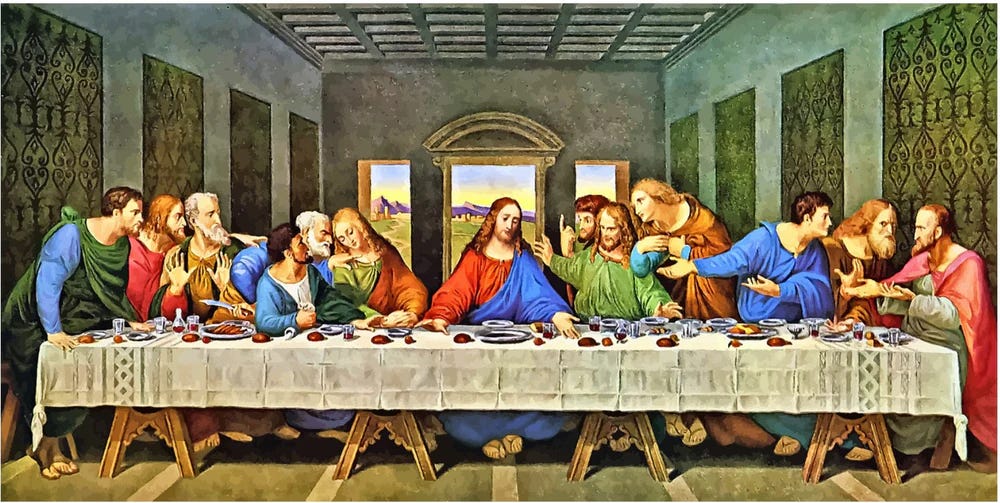
The Last Supper, Leonardo da Vinci
Illness has taken my family again. We’ve had several bouts of flu and cold from the end of March to these holy days of April.
A long time ago, I was told that a repetitive ailment in one’s body or a frustrating foible in one’s character was proof positive that God was trying to humble you, help you learn something by leaning on Him alone.
Being a rather imperfect penitent, I’m sure that many more chances to lean on the Almighty are headed my way, the present illness notwithstanding.
Thus, today’s meditation will be brief, as I best get back to bed…
Farewell to Friends
It is impossible to count how many “last suppers” I’ve had over my nigh 20 years of adulthood. On dozens of occasions, thanks to our wondrous economic and social system that have been a wee bit unstable in what was supposed to be “my prime,” I’ve had the bittersweet opportunity to bid my friends adieu over good food and drink.
At nice restaurants, in crappy basement suites, on remote train station platforms, and, of course, at plenty of pubs, I have said goodbye to my comrades, some of whom were my oldest friends, some of whom I’ve only known for a couple of months.
In other words, the coding, particularly in men, for a proper “valediction forbidding mourning,” is so deep that it need not be taught. Parting gifts, long speeches, toasts, and feasting are things that manifest unconsciously, instinctively, without prejudice.
Finally, people can still recall a last meal with someone decades later. Folks might forget what all the fuss was about, or what project exactly we completed, or what conflict might have been resolved. But food, drink, and “fare-thee-wells” echo for eternity in the minds of men, regardless of their place on the bell-curve.
Thus, it makes sense that Christ’s final moments with his disciples are at supper. And at that meal, as well as afterwards, He exhorts them, giving his final instructions:
“Be not afraid.”
“In my Father’s house their are many rooms.”
“I am the vine, you are the branches.”
“Love one another, as I have loved you.”
Of course, this is also the instance where Our Lord Jesus Christ institutes the Eucharist, giving us His body, blood, soul, and divinity for the long journey between His First and Second Coming.
Of course, the apostles would have recalled all of this had it happened at midday, or at a pier as Christ sailed off into the sunset. But again, grace builds on nature. And it is the nature of mankind to break bread and take oaths with cups in hand in the evening when the days work is finished and there is at last time to repose, or recline at table…
A Layman’s Take on the Eucharist
My non-papist readers may not like this part.
But instead of butchering any explanation of “transubstantiation” or the like, I’m simply going to proffer a paradigm that doesn’t get much play nowadays, outside of science fiction.
What if there is a way to step out of time?
Or, rather, what if time is not nearly the totalizing trait of our 3D space as it appears?
Given that God is outside of time, and that Christ is the incarnation, word become flesh, would that not mean that Christ is also not limited by time?
And if that is so, can it not be possible that EVERY time we come to Communion, it really is Christ at his last supper, giving us his body and blood in the form of bread and wine?
This is the simplest explanation I have for anyone who asks me about doctrine or dogma that surrounds the Eucharist.
Of course it’s a profound mystery. But God giving Himself to us in the species of bread and wine is not outside of His ability. It may be outside of our wisdom, hence the foolishness to the Greeks.
But once again, I’ll refer to that ancient invocation: O God, in whom we move and have our being.
The Eucharist is God giving Himself to us sacramentally to use that terminology. But if God sustains our very existence in every other sense, why is the body, blood, soul, and divinity of Christ so hard to accept in the bread and wine?
We are all St. Peter
We have all denied Christ, more times than Saint Peter did.
At work, at home, in the car as we cuss at others, in our hearts as we wish to avoid a hard task made manifest by our beliefs.
Jesus brought his friends with Him to the Garden of Gethsemane. He asked them to stay awake and pray with Him, at this dark hour. Jesus was clearly in distress, pleading with God, sweating drops of blood.
His closest friends yawned and fell asleep. If any stayed awake, one can imagine them talking amongst themselves, perhaps about the most banal of topics, like folks at the back of church trying to socialize during the service.
Finally, Judas Iscariot arrives with a mob - torches, pitchforks, corrupt cops, the works.
The disciples skirmish briefly - Battle of Gethsemane, Spring 33 AD, Casualties: one lopped off ear (healed), one Savior taken into custody - and then scatter like frightened children.
But Peter doubles back. He follows his Lord, whom he loves, terrified as he is of the powers that be. Maybe he can break Him out of custody? Maybe he can pay Jesus’ bail and get him back to Galilee? Peter is likely praying, bargaining, going through his stages of grief.
Finally, while warming up next to the fire, Peter is cross-examined by others waiting outside the court. They can hear his accent. His physiognomy also betrays his birth. At last, it’s remembered that he was seen with Jesus at his arrest.
Thrice does Peter deny knowing Christ.
And then the cock crows.
“You will deny me three times,” Peter recalls Jesus telling him.
The guilt is too much, and Saint Peter, the rock upon which Christ builds His Church, runs away, stricken with his own betrayal.
We have all done this. We will all do this. Countless times. And yet, Christ’s grace never abates. He is ever ready to forgive. But will we ask Him, humbly?
How have I denied Christ this season? Have I been inhospitable to those who I know are passing through, perhaps for the last time? Can I keep watch with Christ, knowing that He prays with me? What time have I devoted to meditation upon His Passion and death?
- Redbear